
Accelerator
AI Knowledge Platform
A governed AI layer that turns your approved documents, policies and guidance into plain-language, source-backed answers – usable at the point of decision.

The problem
Your organisation already has the information. People just cannot use it in the moment.
Policies, contracts, procedures, technical guidance, operational updates – the answer almost always exists somewhere. The friction is structural: knowledge is written for completeness, stored across multiple systems, and interpreted manually every time it is needed.
We call this Knowledge Latency: the gap between approved knowledge existing centrally and the people who need it being able to apply it confidently at the point of decision.
Why knowledge access breaks down
Even organisations with mature document management practices struggle to apply their own knowledge consistently. The same patterns appear across industries.
01Documents are written for compliance, not for queries
Policies and procedures are written for completeness and audit, not for someone trying to make a decision in two minutes. Reading the right section to answer a specific question takes time most people don't have.
02Knowledge is fragmented across systems, versions and owners
Policies sit in SharePoint. Contracts live in a separate repository. Operational guidance arrives by email. Technical specs are scattered across PDFs, spreadsheets and slide decks. There is no dependable way to reconcile differences – or even know which version is current.
03Search returns files, not conclusions
Even good document search hands you a list of documents to read. Interpretation remains manual and inconsistent. Two people with the same question often arrive at two different answers – and neither knows which is right.
04Every unclear case escalates to an expert
When systems cannot provide a clear answer, the question goes to legal, compliance, finance or a senior operational lead. Routine clarifications consume expert time. Decisions wait. And the same questions tend to come back, week after week.
The solution
Approved documents in. Source-backed answers out.
The AI Knowledge Platform is a governed layer that sits over your existing documentation. Central teams keep control of what the platform is allowed to know. Everyone else gets plain-language answers – with a visible route back to the source.
No open-web search. No uncontrolled public content. No unsupported answers.
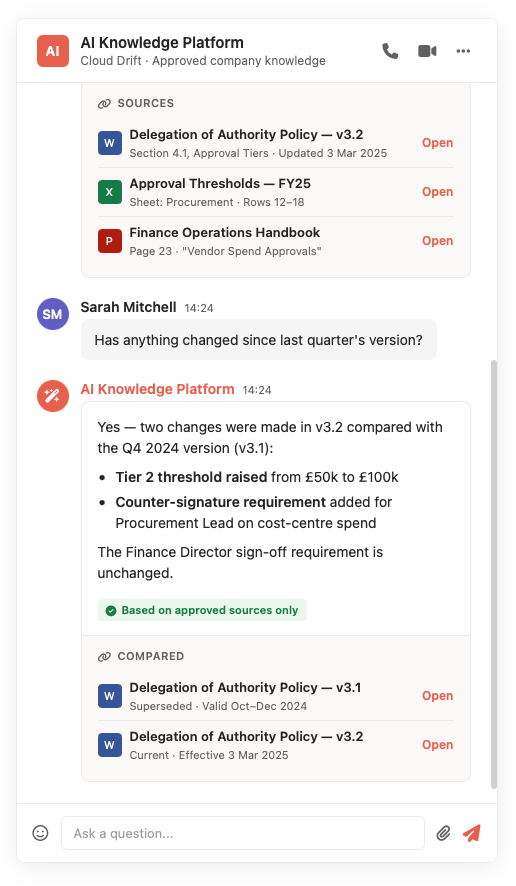
It works with what you have
PDFs (including documents with embedded images and diagrams), Word, Excel, PowerPoint, Visio, SharePoint, Confluence, file shares, intranets, internal URLs. The platform ingests and structures your approved content, links related material across sources, and respects existing access controls.
Users ask questions through familiar channels – Microsoft Teams, Slack, or a web interface – without needing to know file names, folder structures or internal terminology.
Imagine asking...
Finance / shared services →
Which approval rule applies to a £75k spend under the updated delegation-of-authority policy?
Has the supplier onboarding process changed since the last revision, and what's different?
Industrial / field operations →
What's the current procedure for this assembly under revision C of the technical manual?
Compliance / legal →
What does our standard contract say about data retention for European clients?
Distributed operations / partner networks →
Which guidance applies to this scenario at the point of sale, and where can I find the source?
How it works
From document to answer – in four steps.
An AI-powered knowledge layer that ingests your approved content, structures it for retrieval, and serves source-backed answers through the tools your teams already use.
Ingest
Approved content flows in from SharePoint, Confluence, file shares, intranets and internal URLs.
The platform handles multiple formats: PDFs with embedded images, Word, Excel, PowerPoint, Visio diagrams, and structured knowledge bases.
Structure
- AI extracts meaning, not just text.
- Links related policies, contracts and guidance.
- Applies metadata, validity dates and access rules so the platform knows what content is, when it applies, and who can see it.
Ask
Users ask questions in plain language through Microsoft Teams, Slack or a web chat, e.g.:
What's the latest approved guidance on warranty exceptions for this product line?
Answer
- Clear, plain-language response grounded only in approved sources.
- Direct links back to the document, page or section used.
- Conflicts, gaps or uncertainty are surfaced rather than hidden.
Content management phase
Central teams upload, organise and maintain approved content with metadata, validity dates and access rules. The platform re-indexes automatically as content changes – no manual rework when policies are updated.
Daily-use phase
This is where users work. They ask questions in the tools they already use, get source-backed answers, and escalate only when the platform itself flags genuine ambiguity. No new system to learn.
Trust by design
Speed only matters if the answer can be trusted.
The platform is not designed to make AI the new source of truth. It is designed to make your approved knowledge easier to access – while keeping the business in control of the content behind every answer.
- Approved sources only
Answers are generated only from controlled content you have approved. No open-web search. No public sources sneaking in. - Controlled access
Knowledge is tailored by role, team, market or function. People see what they are allowed to see – no more, no less. - Visible evidence
Every answer links back to the source document, with page or section references. Users see exactly where the answer came from. - Usage visibility
Central teams see what is being asked, which content is relied on most, and where users hit ambiguity. Governance becomes an operating signal, not an afterthought.
This is what separates a governed knowledge platform from a generic chatbot.
Users trust the answer. Auditors can verify the logic. Central teams keep ownership of the truth.

Built for distributed operations
Where central knowledge is defined and local teams execute.
Many organisations operate through distributed models: franchises, dealer networks, partner ecosystems, regional operators, field engineering teams, multi-entity finance functions. Guidance is defined centrally. Execution happens locally. Operators are accountable for compliance but not embedded in central teams.
In these environments, knowledge latency is most visible – and most expensive. Local teams rely on outdated instructions. Interpretations diverge. Customers receive inconsistent answers. Central teams only see the problem after issues surface externally.
What changes
- One authoritative interpretation of centrally issued documentation, available wherever decisions are made.
- Consistent answers at the point of need – sales conversations, service interactions, operational handovers.
- Clear traceability back to source material, so local accountability is supported, not undermined.
- Reduced central support burden – HQ teams focus on exceptions and improvements, not repetitive look-ups.
- Faster adoption of updates – when central guidance changes, the network applies it the same day, not weeks later.
Central teams retain control of approved knowledge. Distributed teams get faster access to usable answers. The organisation gains visibility into what people actually need to know.
The pattern works wherever complex guidance has to travel from a centre to the edge: automotive retail, financial services branch networks, franchise operations, regulated advisory firms, manufacturing field service, and multi-entity professional services.
What central teams learn
The platform doesn't only answer questions – it shows what the organisation is trying to understand.
Every interaction generates a signal. Over time, those signals tell central teams where guidance is clear, where it isn't, and where additional content would have the biggest impact.
Recurring questions
The topics that keep coming back. A signal that guidance exists but isn't easy to find – or isn't quite landing.
High-demand content
The documents, policies and updates the organisation actually relies on. The shortlist worth keeping current and accurate above all else.
Content gaps
Questions the platform struggles to answer. A direct prompt for where new or clarified guidance is needed.
We offer a hands-on pilot
Give us access to a sample of your documentation, and we'll build a working proof of concept on your real content – tailored to your domain and access model.
- No lengthy procurement
- No commitment beyond the pilot
- A practical demonstration of governed, source-backed answers on your own documents

Our insights
Case studies, articles, and thought leadership from our senior engineering team.
View all →Document Intelligence & Expert Knowledge Chatbot
Organisations maintain vast documentation that is inaccessible when decisions must be made. A document intelligence chatbot makes documented knowledge usable in day-to-day work.
Read more → blog 26 Jan 2026When Consulting Workflows Break, Clients Feel It First
Strong teams and capable tools don't prevent operational issues when systems are disconnected. The solution isn't replacing systems – it's aligning them.
Read more →